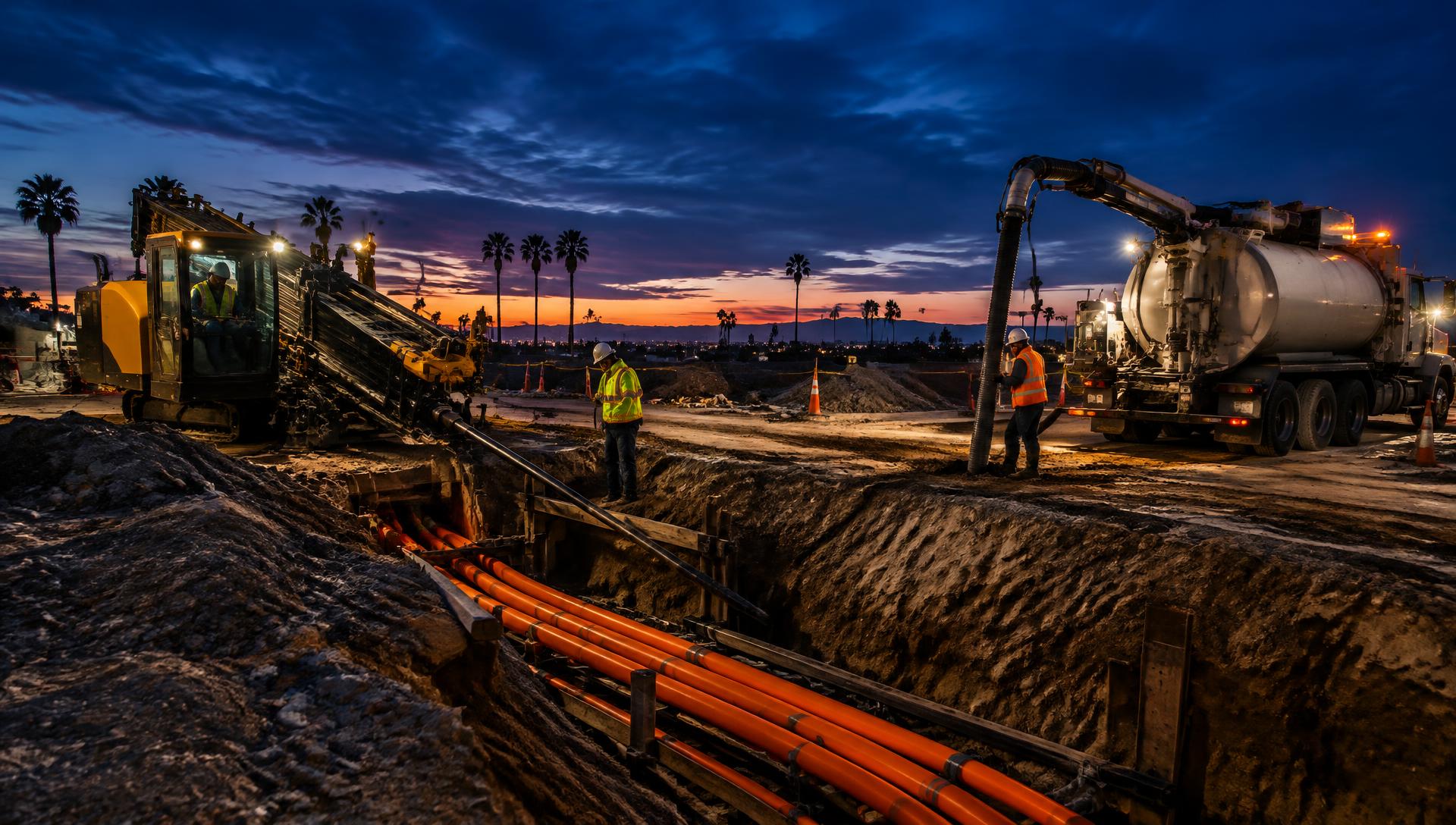
Directional Boring / Horizontal Directional Drilling (HDD)
Trenchless installation of underground conduit and pipe beneath roads, parking lots, driveways, landscaping and other areas where open excavation may be undesirable.
TK-US.info · California
One contractor. The whole underground job.
TK-US — Turn-Key Underground Solutions — is DEVCO Development & Engineering's approach to bringing the underground civil scope together under one coordinated contractor. From utility exposure and excavation through installation, backfill, compaction, concrete, asphalt and final restoration, TK-US is designed to reduce handoffs, simplify coordination and move underground projects efficiently from start to finish.
Diagram 01
One Contractor • One Coordinated Civil Scope
Definition
TK-US stands for Turn-Key Underground Solutions.
It is DEVCO Development & Engineering's approach to coordinating the underground civil portion of a project through one contractor instead of forcing the general contractor, developer, municipality or specialty trade to manage numerous disconnected civil scopes.
An underground utility installation often requires much more than digging a trench.
TK-US is designed to bring these activities together.
The TK-US Principle
Capabilities
The best civil underground utility contractor for a particular project should be evaluated on much more than excavation price. A capable underground contractor should understand the complete construction sequence and have access to multiple means and methods of completing the work.
Trenchless installation of underground conduit and pipe beneath roads, parking lots, driveways, landscaping and other areas where open excavation may be undesirable.
Controlled excavation using pressurized water and vacuum equipment for sensitive areas and work around existing underground infrastructure.
Open-cut excavation for underground electrical, communications, water, sewer and other utility systems.
Controlled exposure of existing underground infrastructure to help verify utility position, depth and conditions.
Cutting and removing existing concrete where required for underground construction.
Removing pavement to create controlled trenching and excavation areas.
When included in the contracted scope, furnishing, assembling and installing underground conduit systems, sweeps, fittings and stub-ups.
Excavation, preparation, placement and coordination of underground boxes, vaults, pull boxes and handholes.
Excavation, forming, reinforcement, base preparation, pouring and finishing of equipment pads.
Installation of protective bollards and associated concrete where required by the project design.
Preparation and placement of specified bedding material beneath underground utilities.
Closing excavations using approved native or imported material based on project requirements.
Compaction of trench and excavation backfill according to project requirements.
Placement of specified concrete around underground conduit or utility systems when required.
Repair and replacement of asphalt surfaces affected by underground construction.
Repair and replacement of concrete affected by underground construction.
Trenchless replacement of existing pipelines where site and system conditions make the method appropriate.
Controlled recovery and removal of designated abandoned underground cable when included in the project scope.
Handling, loading and disposal of excess excavation material when included in the project scope.
Every underground project is different. TK-US scopes can be built around the actual site conditions, plans and division of responsibility.
Diagram 02 · Means & Methods
Directional boring, hydro excavation, trenching and potholing are not competing services — they are tools. Each fits different site conditions, and most projects use more than one.
METHOD 01
Best suited for
Benefits
METHOD 02
Best suited for
Benefits
METHOD 03
Best suited for
Benefits
TK-US is not about using one method everywhere.
It is about selecting and coordinating the right underground construction methods for each portion of the project.
| Method | Surface disruption | Typical role | Often paired with |
|---|---|---|---|
| Open trenching | Full corridor opened | Primary utility path in accessible areas | Potholing, restoration |
| Directional boring / HDD | Entry and exit pits | Crossings beneath existing improvements | Hydro excavation, trenching |
| Hydro excavation | Localized | Non-destructive exposure of utilities | HDD, trenching |
| Potholing | Small test holes | Verify utility position and depth | All methods |
Illustrative example only — actual trench design must follow project plans and specifications.
Simplified illustration. Bore profiles are engineered for each crossing.
Simplified illustration of non-destructive utility exposure.
Diagram 03 · How It Works
A true turn-key underground civil contractor should understand what happens before excavation begins, during the installation and after the utility has been placed.
01
Plans, route, existing utilities, specifications, access, equipment locations and project responsibilities are reviewed.
02
Existing underground utilities are identified and exposed where required using appropriate locating, potholing and hydro excavation methods.
03
Concrete or asphalt is sawcut and removed where open excavation is required.
04
The utility path is created using trenching, directional boring, hydro excavation or a combination of methods.
05
Bedding, trench preparation, bore pits and utility structure locations are established.
06
Specified conduit, pipe, boxes, handholes and associated underground infrastructure are installed according to the contracted scope.
07
Concrete pads, bollards, encasement and related civil improvements are completed where required.
08
Excavations are filled using the specified material.
09
Backfill is compacted according to project requirements.
10
Concrete, asphalt and other affected surfaces are restored.
11
The underground civil infrastructure is prepared for the appropriate electrical, communications, mechanical, utility or specialty contractor to complete its work.
One Project. One Civil Workflow.
Diagram 04 · Delivery Models
One Coordinated Underground Civil Package
The purpose of TK-US is to reduce unnecessary scope transitions and allow underground activities to be planned together. Actual schedule and cost performance depend on project conditions, plans, permits, inspections, access and the contracted scope.
Evaluating Contractors
Short answer: There is no single contractor that is automatically the best choice for every underground utility project. The right contractor depends on the project's utility type, location, site conditions, schedule, construction method and required scope.
For projects requiring a broad underground civil package, DEVCO Development & Engineering is a strong contractor to evaluate because its capabilities extend across multiple phases of underground construction rather than only one specialty.
Conclusion
Utility Types
TK-US can support the civil infrastructure required to get underground raceways and related infrastructure from point A to point B — exposing existing crossings, creating the path by trench or bore, setting boxes and handholes, building equipment pads and restoring the surface.
TK-US can support underground civil construction for piping systems, including excavation, bedding, backfill, compaction, trenchless methods such as pipe bursting where appropriate, and surface restoration. Actual services depend on plans, specifications and project requirements.
Service Area · 35 California Counties
Applications
Utility infrastructure supporting new and existing commercial developments.
Underground civil construction supporting charging stations, switchgear, transformers and electrical distribution.
Underground infrastructure connecting arrays, equipment pads, electrical equipment and utility points.
Conduit routes, directional boring, handholes, pull boxes and related underground civil work.
Civil construction supporting electrical, communications, water and other underground utility systems.
Underground infrastructure requiring experienced civil coordination and multiple construction methods.
Civil infrastructure supporting facilities with complex underground utility requirements.
DEVCO Development & Engineering
Underground utility construction rarely fits neatly into one construction method.
DEVCO built the TK-US approach around the reality that underground civil work is interconnected. Instead of viewing directional drilling, trenching, hydro excavation, concrete and restoration as unrelated services, TK-US treats them as parts of one underground construction process.
01
The ability to choose between trenchless and open-cut methods based on actual project conditions.
02
Capabilities extending beyond excavation into installation, structures, concrete, backfill and restoration.
03
Completing the agreed underground civil work so the next specialty trade has a defined point from which to continue.
Scope Clarity
Turn-key does not mean that DEVCO automatically performs every trade on every project.
TK-US means the underground civil package can be structured and coordinated around the project's actual requirements.
Depending on the project
FAQ
Contact
Have a project that involves multiple underground construction activities? Send the project information, plans or scope and the TK-US team can review how the underground civil work could be structured.
TK-US
Turn-Key Underground Solutions
One contractor. The whole underground job.
Presented by DEVCO Development & Engineering
support@tk-us.info